
10 Flooring Ideas for Outdoor Patio Spaces

The most attractive patio surface isn't automatically the best one. A finish can photograph beautifully and still fail in a wet climate, feel scorching underfoot, demand constant sealing, or clash with the home's architecture once it's installed. The better approach is to start with use, climate, drainage, foot traffic, barefoot comfort, maintenance tolerance, and whether the patio has to present cleanly in property photography.
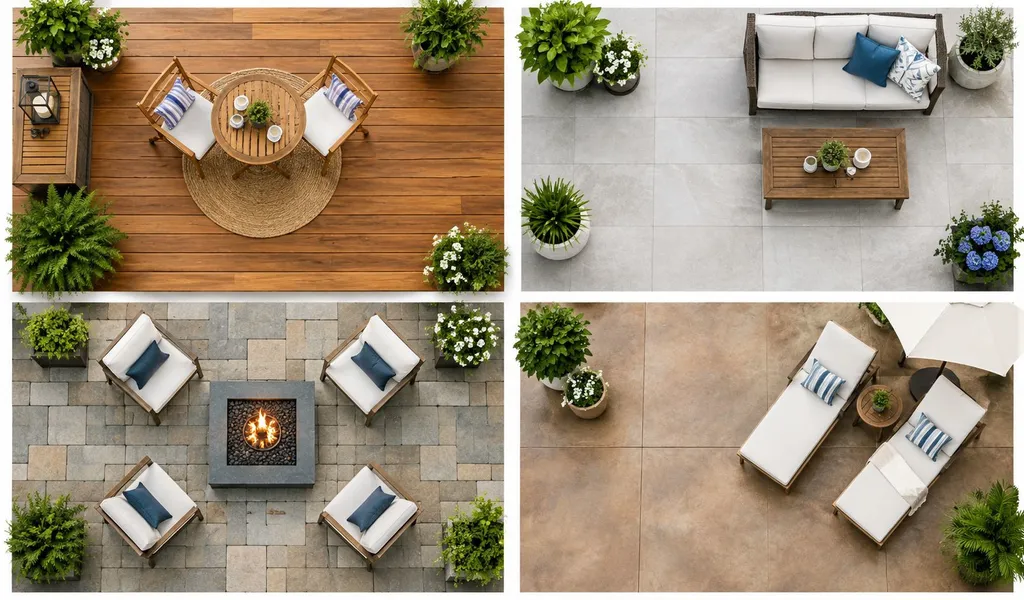
That's the lens I'd use for any set of flooring ideas for outdoor patio spaces. Some surfaces win on durability, some on price, some on visual warmth, and some on drainage or slip resistance. RoomStaging can help visualize exterior materials, finishes, furniture, and landscaping before a renovation decision, so you can compare a few directions side by side instead of guessing from samples alone.
Table of Contents
- 1. Natural Stone Pavers
- 2. Composite Decking and Pavers
- 3. Permeable Pavers and Eco-Friendly Flooring
- 4. Stamped Concrete Patios
- 5. Porcelain Tile Pavers
- 6. Brick and Interlocking Pavers
- 7. Gravel and Crushed Stone Patios
- 8. Concrete Slab Patios
- 9. Wooden Deck Flooring for Patios
- 10. Travertine and Limestone Pavers
- Patio Flooring: 10 Options Compared
- Match the Surface to the Property's Priorities
1. Natural Stone Pavers
Natural stone pavers are the safest choice when the patio needs to feel permanent, architectural, and tied to the house. Granite, slate, limestone, and travertine all bring real texture, and that texture usually reads well in photos because it catches light unevenly instead of looking flat.
Where natural stone works best
Stone makes the most sense on properties that need a premium first impression, but the specific stone matters. Travertine leans warm and Mediterranean, slate feels sharper and more contemporary, and limestone sits in the middle with a softer, quieter look. On a home with brick, stucco, or mature landscaping, stone usually feels integrated rather than added on.
Practical rule: choose stone when you want the patio to look better as it ages, not just on installation day.
The trade-off is maintenance and careful installation. Stone still needs proper slope for drainage, and porous options usually need sealing to keep stains and weathering under control. If the house sits in a region with frequent rain or freeze-thaw swings, texture and finish matter more than color alone.
A staging detail matters here too. Stone photographs best when the image includes depth, shadows, and layered landscaping, because flat wide shots can make even expensive materials look ordinary. RoomStaging's exterior redesign feature is useful when you want to test whether a lighter stone, a darker slate, or a mixed layout fits the facade before anyone starts setting pavers.
2. Composite Decking and Pavers
Composite is the practical choice for owners who want a finished patio without a yearly maintenance project. It fits investment properties, coastal homes, and busy households because it looks controlled on day one and stays that way with far less upkeep than wood.
Where composite wins and where it stops
Composite decking photographs well because the color is consistent and the surface reads cleanly in wide exterior shots. It suits patios that connect directly to the house and need a deliberate transition instead of a patchwork of finishes. For a homeowner comparing options, that predictable look is often the main reason to choose it.
The trade-off is heat, detailing, and structure. Composite still needs the right joist spacing, and manufacturers commonly call for 16 inches on center for standard installs, with tighter spacing for diagonal or herringbone patterns according to manufacturer guidance. Expansion gaps also matter because the material moves with temperature, and poor spacing can lead to buckling.
Installation note: composite is easy to live with, but it is unforgiving of weak framing or ignored thermal movement.
The design choice comes down to what the patio needs to do. If the brief calls for a warmer, more natural feel, wood still has the edge. If the priority is a cleaner, more controlled look with fewer maintenance demands, composite usually wins. RoomStaging's exterior design feature can help test whether a cooler gray or warmer brown better matches the siding and trim before the layout is built.
3. Permeable Pavers and Eco-Friendly Flooring
Permeable pavers solve a practical problem that style boards often skip, water. If the site has drainage issues, runoff pressure, or a hardscape that needs to work with planting beds, permeability becomes a decision about performance first and appearance second. That matters on urban lots, sloped sites, and yards where the patio should handle rain without pushing it toward the wrong place.
When permeability should lead the decision
Permeable systems make sense when the patio needs to shed water without sending it straight into drains or across the yard. They also fit properties that want a more environmentally responsive look, especially with native planting, gravel joints, or a looser planting plan. In listings, that can read as a thoughtful renovation instead of a purely decorative one.
The trade-off is installation and upkeep. The base has to be built correctly, the slope still matters, and the joint material has to suit the climate. If those details are off, the patio loses the benefit that justified it in the first place.
For visually driven buyers, the surface should read as part of the whole outdoor setting, not as a technical workaround. RoomStaging's exterior redesign can help show how the patio blends with plantings, edging, and the rest of the yard so the eco-friendly choice looks deliberate in marketing photos.
Permeable paving only pays off when the base and joint material are specified for the local climate, and it is the wrong choice on a site where a simple slope toward a planting bed solves the runoff.
4. Stamped Concrete Patios
Stamped concrete is a practical choice when the patio needs visual presence without the cost and complexity of full stone work. It can mimic stone, brick, or tile, and it often does the job well in market-ready updates where the surface has to look finished quickly.
Why it stages well
Stamped concrete fits larger patios and straightforward layouts because the pattern can carry the space without demanding a more expensive build-up underneath. It also matches suburban exteriors well, especially when the goal is to make an older slab feel intentional rather than purely functional. In photos, the right mix of texture and color helps it read as a designed surface instead of plain concrete.
The trade-offs are real. The quality depends heavily on the installer, since pattern scale, color depth, and sealer choice can make the surface look convincing or awkward. It also asks for resealing over time, especially in exposed areas that see weather and steady foot traffic.
Architectural style should guide the pattern. A brick stamp suits a Mediterranean facade better than a random stone layout, while clean geometric stamping usually works better with contemporary homes. RoomStaging's exterior redesign tool is useful here because pattern matching is one of the easiest places to get a renovation wrong on paper and right in a preview.
Reserve stamped concrete for large, visible patios where the pattern can read clearly. On small spaces, the stamping can turn busy, and a plain slab with a colored sealer often looks more deliberate.
5. Porcelain Tile Pavers
Porcelain is one of the smartest technical choices for a patio when the space needs to stay crisp, low-maintenance, and visually controlled. Outdoor porcelain pavers combine low water absorption, strong freeze-thaw resistance, and durable performance, which is why they've become a serious option in contemporary outdoor design. Independent flooring guidance also places porcelain in the low-maintenance, long-lifespan tier, with installed costs commonly around $4 to $12 per sq ft and service life often estimated at 25 to 50+ years.
Why porcelain photographs so well
Porcelain reads clean in photos because it doesn't fight the architecture. Large-format tiles create fewer visual interruptions, so the patio feels broader and more orderly. That works especially well for modern homes, luxury listings, and any exterior where the flooring should support the rest of the design rather than dominate it.
Wet safety matters more with porcelain than many buyers expect. For exterior wet surfaces, slip resistance should target a wet DCOF above 0.42 per ANSI A326.3, with 0.6 or higher considered safer around pools and heavy splash zones. That makes textured porcelain and other grippy finishes much more practical than glossy, sealed alternatives.
Good porcelain installation depends on the substrate as much as the tile. If drainage and slope are wrong, even a high-end finish won't perform properly.
Porcelain also works well in mixed-material properties where the patio needs to feel contemporary but not sterile. It pairs cleanly with steel furniture, slim planters, and restrained landscaping, which helps the finished space look intentional in both daylight and listing photos.
6. Brick and Interlocking Pavers
Brick and interlocking pavers belong in the conversation whenever the property needs character more than novelty. Brick gives a traditional, settled look, while modern interlocking concrete pavers deliver the same kind of modular patterning with more flexibility in installation and repair.
Best use cases for brick
Historic homes, colonial facades, cottage-style properties, and any project with visible chimneys or period materials usually benefit from brick. The material feels believable next to heritage landscaping, curved borders, and older masonry details. In property photography, that kind of cohesion matters because it helps the outdoor area look like part of the original house instead of an add-on.
Interlocking pavers are more versatile than many owners realize. They can be set in herringbone, running bond, or basket-weave patterns, and repairs are simpler because damaged units can be replaced individually. That makes them practical for owners who care about both appearance and future access.
The trade-off is that brick can require joint care and occasional repointing in mortar-set systems. It also needs proper base preparation, or the pattern loses its neatness over time. For a staging-minded renovation, the advantage is that brick usually looks lived-in in a good way, which is hard to fake with smoother materials.
If you're aligning outdoor updates with a broader curb appeal strategy, RoomStaging's front-entry ideas post can help keep the patio and the approach from feeling like separate projects.
7. Gravel and Crushed Stone Patios
Gravel is the fastest path to a casual patio with good drainage and low upfront cost. It also has a useful staging advantage, because fresh gravel can be refreshed quickly before photography or a showing, which keeps the outdoor area from looking tired.
Where gravel wins and where it doesn't
Gravel works well for cabin properties, cottage gardens, Zen-inspired spaces, and transitional yards where the patio is meant to feel relaxed rather than formal. It drains well, it's easy to shape, and it can look surprisingly intentional when the edges are controlled and the surface is raked clean. For property photos, the best version usually shows a defined seating zone, crisp edge restraints, and gravel that complements the siding rather than competing with it.
Its weakness is maintenance. Gravel migrates, collects debris, and can feel unstable under lightweight furniture if the base isn't prepared properly. Barefoot comfort is also limited, especially with sharper aggregate. Still, for budget projects, it covers a lot of ground.
Gravel is strongest when the design is simple. The more you ask it to behave like a formal patio, the less convincing it becomes.
If the space already leans toward naturalistic landscaping, RoomStaging's landscaping curb appeal ideas can help you match gravel color, planting texture, and edging so the final result feels coherent in images.
8. Concrete Slab Patios
Concrete works best when the patio needs to be practical first and decorative second. It gives a clean, controlled base that suits modern homes, and it can stay plain or take on more character later through staining, stamping, or polishing.
Why plain concrete still gets chosen
The appeal is predictability. Concrete slab patios are straightforward to install, and they avoid the visual clutter that can come with more decorative surfaces. That makes them useful for owners who want durable function with little visual noise. They also photograph well when the slab is sealed, the edges are crisp, and the furniture layout feels deliberate.
Plain concrete still has range. A stain can warm up the tone or cool it down, a broom finish adds grip, and a polished finish can read well in a modern setting. Maintenance stays fairly simple, mostly sealing the surface and keeping water from sitting on it.
The trade-off is visual authority. On a higher-end property, an unbroken slab can feel a little bare unless the rest of the exterior carries enough texture and planting to balance it. A colored sealer or clean edge treatment can help when the facade needs the patio to echo a specific tone. RoomStaging's exterior redesign feature is useful here because a color that looks flat on site can appear more balanced once it sits beside the facade and surrounding plants.
Choose plain concrete when the patio is large, the budget is fixed, and the surrounding yard already supplies the visual interest. Add a colored finish only when the exterior needs the slab to tie into a specific material or paint color.
9. Wooden Deck Flooring for Patios
Wood has a warmth that other patio surfaces can't completely copy. It's softer underfoot, it brings a more inviting texture into the space, and it often reads well in photos because the grain and finish catch light in a natural way.
When wood makes the most sense
Wooden deck flooring is especially strong when the patio needs to feel like an extension of the living room. Raised decks, cottage settings, and homes that rely on a warmer, more tactile outdoor style all benefit from it. Stained wood also gives photographers something concrete to work with, because the grain becomes a visual anchor in wide shots and close-ups alike.
The downside is upkeep. Wood needs regular care, and that reality matters more than the initial look. Composite can mimic the appearance, but actual wood still has the advantage of authenticity and tactile comfort. If the owner is prepared for seasonal maintenance and resealing, wood can age beautifully. If not, it can start looking neglected fast.
Practical rule: choose wood when the owner will maintain it, not when they only like the first-year photo.
From an installation standpoint, thermal movement, drainage, and airflow all matter. A well-detailed wood patio feels rich and honest. A poorly detailed one starts cupping, fading, or showing wear in places that are hard to disguise.
10. Travertine and Limestone Pavers
Travertine and limestone sit in the premium lane, especially when the patio has to project calm luxury rather than trendiness. These stones have warm, neutral tones that pair easily with Mediterranean, Spanish colonial, transitional, and upscale modern architecture. Their natural surface variation gives them character without making the space feel busy.
Why they read as high-end
Travertine is particularly strong around pool decks and sunny patios because its color and texture feel relaxed rather than harsh. Limestone is subtler, which makes it useful when the goal is visual continuity across a larger outdoor space. Both materials can enhance a property's presentation because they feel purpose-built instead of decorative.
The downside is maintenance and care discipline. These stones are porous, so sealing schedules matter, and finish choice matters too. Filled or polished surfaces can feel more contemporary, while natural pitting keeps the rustic Mediterranean look alive. If the climate is wet or the surface sees a lot of splash, traction has to be part of the decision, not an afterthought.
Travertine and limestone are best when the patio is part of a broader premium exterior story. They aren't the cheapest choice, and they aren't the lowest-maintenance choice. They're the ones you choose when the patio needs to look finished, durable, and architecturally credible for years.
Patio Flooring: 10 Options Compared
| Option | Implementation complexity | Resource requirements | Expected outcomes | Ideal use cases | Key advantages |
|---|---|---|---|---|---|
| Natural Stone Pavers | High, skilled masons and precise laying | Premium stone, heavy labor, higher upfront cost | Very durable (20+ yrs), premium natural aesthetic, periodic sealing | Luxury, mixed-style homes, high-end listings | Timeless look, high perceived value, authentic variation |
| Composite Decking and Pavers | Medium, standard decking techniques, specialist fasteners | Manufactured boards, moderate-to-high material cost, lower ongoing labor | Low maintenance, uniform appearance, long service life with warranties | Low-maintenance suburban, coastal, investment properties | Weather-resistant, consistent visuals, minimal upkeep |
| Permeable Pavers and Eco-Friendly Flooring | Medium–High, careful base and drainage design required | Permeable units or recycled materials, proper drainage base, moderate cost | Reduced runoff, code compliance potential, sustainable appeal | Water-sensitive regions, eco-focused buyers, regulated developments | Stormwater management, sustainability, reduced flooding risk |
| Stamped Concrete Patios | Medium, concrete pour with stamping and coloring skill | Concrete, stamping tools, experienced crew, lower material cost | Cost-effective simulated stone/brick look, needs resealing, moderate longevity | Budget staging, large areas needing cohesive look | Low cost vs. stone, extensive pattern options, fast install |
| Porcelain Tile Pavers | High, skilled tile setters, precise substrate and drainage | Premium porcelain, grout/sealants, higher install cost | Non-porous, stain- and frost-resistant, contemporary finish, grout maintenance | Luxury/contemporary homes, freeze-thaw climates, premium staging | Durable, wide style range, low water absorption |
| Brick and Interlocking Pavers | Medium, modular laying; mortar joints add complexity | Individual units, base prep, moderate labor, variable material cost | Timeless aesthetic, replaceable units, good longevity with maintenance | Historic, colonial, cottage-style properties | Repairability, classic charm, diverse patterns |
| Gravel and Crushed Stone Patios | Low, minimal installation, rapid setup | Low-cost aggregate, simple tools, minimal labor | Economical and highly drainable, requires frequent upkeep (raking/replenish) | Rustic cabins, quick-flip staging, informal landscapes | Lowest cost, fast install, easy to refresh or remove |
| Concrete Slab Patios | Low–Medium, straightforward pour and finishing | Concrete, basic labor, low material cost | Economical, versatile foundation, prone to hairline cracks, needs sealing | Budget properties, modern/minimalist homes, accessible surfaces | Most cost-effective, smooth/accessible surface, versatile |
| Wooden Deck Flooring for Patios | Medium–High, framing and precise installation, possible permits | Lumber (treated/hardwood/engineered), regular maintenance supplies | Warm, inviting aesthetic, comfortable underfoot, ongoing upkeep | Transitional indoor-outdoor homes, lifestyle-focused staging | Strong emotional appeal, tactile comfort, design flexibility |
| Travertine and Limestone Pavers | High, careful handling, sealing, skilled installers | Premium natural stone, higher cost, periodic sealing and care | Sophisticated luxury look, cool surface in sun, moderate maintenance | Luxury, Mediterranean, pool surrounds, high-end listings | Elegant warm tones, cool to touch, high prestige |
Match the Surface to the Property's Priorities
The right patio floor usually becomes obvious once the decision order is right. Start with drainage and climate demands first, because a surface that looks great but fails in wet weather or freeze-thaw cycles will become a problem fast. Then decide how much maintenance the owner will really accept, because wood, stone, concrete, composite, and porcelain all demand different levels of care.
After that, match texture and color to the home's architecture. Brick fits heritage properties, porcelain fits contemporary precision, wood adds warmth, composite keeps things low-maintenance, gravel stays relaxed and economical, permeable pavers support drainage-heavy sites, and natural stone or travertine lends a premium presentation. Finally, compare installation complexity and how the finished patio will look in photographs, because a surface that reads beautifully in a listing often helps the rest of the exterior feel more valuable.
The strongest budget-friendly choices are gravel and plain concrete. The strongest low-upkeep choice is composite. Wood gives the most warmth, permeable pavers do the most for drainage, brick carries heritage character, porcelain gives the cleanest modern finish, and natural stone or travertine deliver the most polished premium look. For many projects, the best answer is not the most expensive one, it's the one that fits the site, the owner's maintenance tolerance, and the way the home needs to present.
Before committing, create side-by-side exterior concepts and compare them in context with the facade, furniture, planting, and lighting. That's where RoomStaging is useful, because it helps you visualize the patio as part of the whole property, not as a standalone material sample. If you publish this topic on your site, it also makes sense to add one to four relevant internal RoomStaging feature links and one or two related internal blog links so readers can move from inspiration to planning without leaving your site.
RoomStaging helps you visualize outdoor patio materials before you commit, from stone and porcelain to composite, wood, and concrete. Use RoomStaging to preview exterior redesign concepts, compare finishes in context, and make the final patio choice with more confidence.